Scientific References:
1. Drmic D, Samara M, Vidovic T, Malekinusic D, Antunovic M, Vrdoljak B, Ruzman J, Milkovic Perisa M, Horvat Pavlov K, Jeyakumar J, Seiwerth S, Sikiric P. Counteraction of perforated cecum lesions in rats: Effects of pentadecapeptide BPC-157, L-NAME and L-arginine. World J Gastroenterol. 2018 Dec 28;24(48):5462-5476. doi: 10.3748/wjg.v24.i48.5462. PMID: 30622376; PMCID: PMC6319139.
2. Huang T, Zhang K, Sun L, Xue X, Zhang C, Shu Z, Mu N, Gu J, Zhang W, Wang Y, Zhang Y, Zhang W. Body protective compound-157 enhances alkali-burn wound healing in vivo and promotes proliferation, migration, and angiogenesis in vitro. Drug Des Devel Ther. 2015 Apr 30;9:2485-99. doi: 10.2147/DDDT.S82030. PMID: 25995620; PMCID: PMC4425239.
3. Amic F, Drmic D, Bilic Z, Krezic I, Zizek H, Peklic M, Klicek R, Pajtak A, Amic E, Vidovic T, Rakic M, Milkovic Perisa M, Horvat Pavlov K, Kokot A, Tvrdeic A, Boban Blagaic A, Zovak M, Seiwerth S, Sikiric P. Bypassing major venous occlusion and duodenal lesions in rats, and therapy with the stable gastric pentadecapeptide BPC-157, L-NAME and L-arginine. World J Gastroenterol. 2018 Dec 21;24(47):5366-5378. doi: 10.3748/wjg.v24.i47.5366. PMID: 30598581; PMCID: PMC6305534.
4. Duzel A, Vlainic J, Antunovic M, Malekinusic D, Vrdoljak B, Samara M, Gojkovic S, Krezic I, Vidovic T, Bilic Z, Knezevic M, Sever M, Lojo N, Kokot A, Kolovrat M, Drmic D, Vukojevic J, Kralj T, Kasnik K, Siroglavic M, Seiwerth S, Sikiric P. Stable gastric pentadecapeptide BPC-157 in the treatment of colitis and ischemia and reperfusion in rats: New insights. World J Gastroenterol. 2017 Dec 28;23(48):8465-8488. doi: 10.3748/wjg.v23.i48.8465. PMID: 29358856; PMCID: PMC5752708.
5. Vukojević J, Siroglavić M, Kašnik K, Kralj T, Stanćić D, Kokot A, Kolarić D, Drmić D, Sever AZ, Barišić I, Šuran J, Bojić D, Patrlj MH, Sjekavica I, Pavlov KH, Vidović T, Vlainić J, Stupnišek M, Seiwerth S, Sikirić P. Rat inferior caval vein (ICV) ligature and particular new insights with the stable gastric pentadecapeptide BPC-157. Vascul Pharmacol. 2018 Jul;106:54-66. doi: 10.1016/j.vph.2018.02.010. Epub 2018 Mar 3. PMID: 29510201.
6. Drmic D, Kolenc D, Ilic S, Bauk L, Sever M, Zenko Sever A, Luetic K, Suran J, Seiwerth S, Sikiric P. Celecoxib-induced gastrointestinal, liver and brain lesions in rats, counteraction by BPC-157 or L-arginine, aggravation by L-NAME. World J Gastroenterol. 2017 Aug 7;23(29):5304-5312. doi: 10.3748/wjg.v23.i29.5304. PMID: 28839430; PMCID: PMC5550779.
7. Hsieh MJ, Liu HT, Wang CN, Huang HY, Lin Y, Ko YS, Wang JS, Chang VH, Pang JS. Therapeutic potential of pro-angiogenic BPC-157 is associated with VEGFR2 activation and up-regulation. J Mol Med (Berl). 2017 Mar;95(3):323-333. doi: 10.1007/s00109-016-1488-y. Epub 2016 Nov 15. PMID: 27847966.
8. Grabarevic Z, Tisljar M, Artukovic B, Bratulic M, Dzaja P, Seiwerth S, Sikiric P, Peric J, Geres D, Kos J. The influence of BPC-157 on nitric oxide agonist and antagonist-induced lesions in broiler chicks. J Physiol Paris. 1997 May-Oct;91(3-5):139-49. doi: 10.1016/s0928-4257(97)89478-8. PMID: 9403788.
9. Škrlec K, Ručman R, Jarc E, Sikirić P, Švajger U, Petan T, Perišić Nanut M, Štrukelj B, Berlec A. Engineering recombinant Lactococcus lactis as a delivery vehicle for BPC-157 peptide with antioxidant activities. Appl Microbiol Biotechnol. 2018 Dec;102(23):10103-10117. doi: 10.1007/s00253-018-9333-6. Epub 2018 Sep 6. PMID: 30191288.
10. Sikiric P, Seiwerth S, Brcic L, Blagaic AB, Zoricic I, Sever M, Klicek R, Radic B, Keller N, Sipos K, Jakir A, Udovicic M, Tonkic A, Kokic N, Turkovic B, Mise S, Anic T. Stable gastric pentadecapeptide BPC-157 in trials for inflammatory bowel disease (PL-10, PLD-116, PL 14736, Pliva, Croatia). Full and distended stomach, and vascular response. Inflammopharmacology. 2006 Dec;14(5-6):214-21. doi: 10.1007/s10787-006-1531-7. PMID: 17186181.
11. Sikiric P, Seiwerth S, Rucman R, Turkovic B, Rokotov DS, Brcic L, Sever M, Klicek R, Radic B, Drmic D, Ilic S, Kolenc D, Vrcic H, Sebecic B. Stable gastric pentadecapeptide BPC-157: novel therapy in gastrointestinal tract. Curr Pharm Des. 2011;17(16):1612-32. doi: 10.2174/138161211796196954. PMID: 21548867.
12. Pevec D, Novinscak T, Brcic L, Sipos K, Jukic I, Staresinic M, Mise S, Brcic I, Kolenc D, Klicek R, Banic T, Sever M, Kocijan A, Berkopic L, Radic B, Buljat G, Anic T, Zoricic I, Bojanic I, Seiwerth S, Sikiric P. Impact of pentadecapeptide BPC-157 on muscle healing impaired by systemic corticosteroid application. Med Sci Monit. 2010 Mar;16(3):BR81-88. PMID: 20190676.
13. Unveiling the Wolverine Peptide: Exploring Its Potential for Healing and Regeneration. Peptide Information (2023)
14. Tokura Y, Nakayama Y, Fukada S, Nara N, Yamamoto H, Matsuda R, Hara T. Muscle injury-induced thymosin β4 acts as a chemoattractant for myoblasts. J Biochem. 2011 Jan;149(1):43-8. doi: 10.1093/jb/mvq115. Epub 2010 Sep 29. PMID: 20880960.
15. Vasilopoulou E, Kolatsi-Joannou M, Lindenmeyer MT, White KE, Robson MG, Cohen CD, Sebire NJ, Riley PR, Winyard PJ, Long DA. Loss of endogenous thymosin β4 accelerates glomerular disease. Kidney Int. 2016 Nov;90(5):1056-1070. doi: 10.1016/j.kint.2016.06.032. Epub 2016 Aug 26. PMID: 27575556; PMCID: PMC5073078.
16. Brady RD, Grills BL, Schuijers JA, Ward AR, Tonkin BA, Walsh NC, McDonald SJ. Thymosin β4 administration enhances fracture healing in mice. J Orthop Res. 2014 Oct;32(10):1277-82. doi: 10.1002/jor.22686. Epub 2014 Jul 8. PMID: 25042765.
17. Cheng P, Kuang F, Zhang H, Ju G, Wang J. Beneficial effects of thymosin β4 on spinal cord injury in the rat. Neuropharmacology. 2014 Oct;85:408-16. doi: 10.1016/j.neuropharm.2014.06.004. Epub 2014 Jun 14. PMID: 24937047.
18. Xiong Y, Mahmood A, Meng Y, Zhang Y, Zhang ZG, Morris DC, Chopp M. Neuroprotective and neurorestorative effects of thymosin β4 treatment following experimental traumatic brain injury. Ann N Y Acad Sci. 2012 Oct;1270:51-8. Doi: 10.1111/j.1749-6632.2012.06683.x. PMID: 23050817; PMCID: PMC3547647.
19. Kleinman HK, Sosne G. Thymosin β4 Promotes Dermal Healing. Vitam Horm. 2016;102:251-75. doi: 10.1016/bs.vh.2016.04.005. Epub 2016 May 24. PMID: 27450738.
20. https://clinicaltrials.gov/show/NCT00598871
21. Exploring the Potential of Thymosin Peptide in Immune Function and Healing. Peptide Information (2023).
22. Goldstein AL, Kleinman HK. Advances in the basic and clinical applications of thymosin β4. Expert Opin Biol Ther. 2015;15 Suppl 1:S139-45. doi: 10.1517/14712598.2015.1011617. Epub 2015 Jun 22. PMID: 26096726.
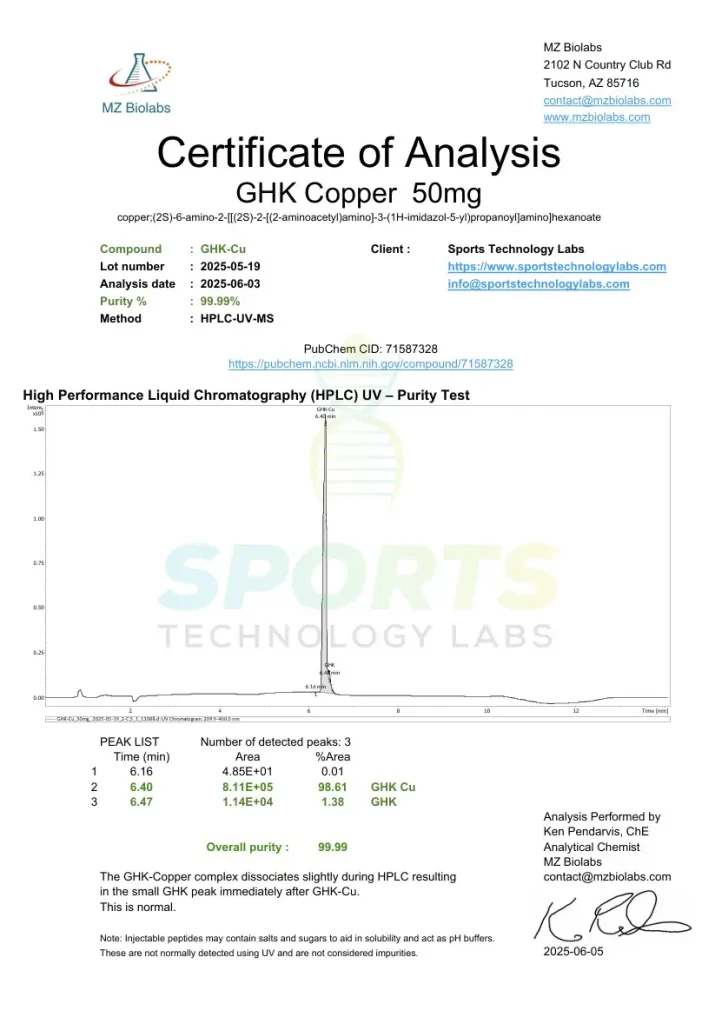
23. Wang, X., Liu, B., Xu, Q., Sun, H., Shi, M., Wang, D., … & Feng, B. (2017). GHK‐Cu‐liposomes accelerate scald wound healing in mice by promoting cell proliferation and angiogenesis. Wound repair and regeneration, 25(2), 270-278.
24. Zhao, R., Chen, Y., Ma, Y., Zou, C., Zhang, J., & Chen, Z. (2022). Innovation and transformation of chronic airway diseases. Frontiers in Molecular Biosciences, 9, 1089813.
25. Lau, S. J., & Sarkar, B. (1981). The interaction of copper (II) and glycyl-L-histidyl-L-lysine, a growth-modulating tripeptide from plasma. Biochemical Journal, 199(3), 649-656.
26. Pickart L, et al. The human tri-peptide GHK-Cu in prevention of oxidative stress and degenerative conditions of aging: implications for cognitive health. Oxidative Medicine and Cellular Longevity. 2012; 2012: 324832. Doi: 10.1155/2012/324832.