| Compound Class | Selective Androgen Receptor Modulator (SARM) · Steroidal · Androgen receptor partial agonist |
|---|---|
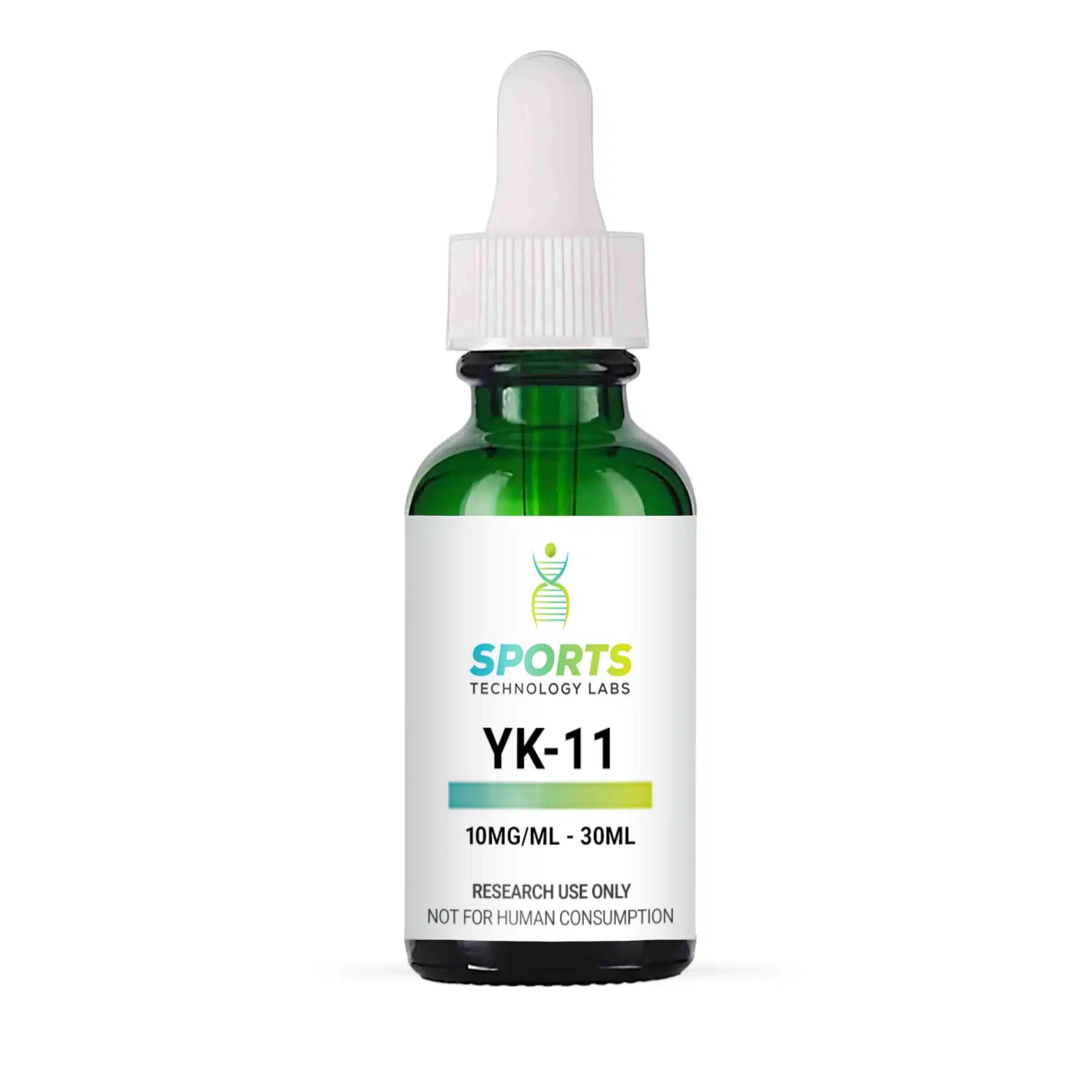
| Concentration | 10 mg/mL |
| Composition | USP-grade PEG-400 base, YK-11 (≥98% purity) |
| CAS Number | 1370003-76-1 |
| Chemical Formula | C25H34O6 |
| Molar Mass | 430.54 g/mol |
| Synonyms | YK-11, YK11 |
| Volume | 30 mL per bottle (300 mg total) |
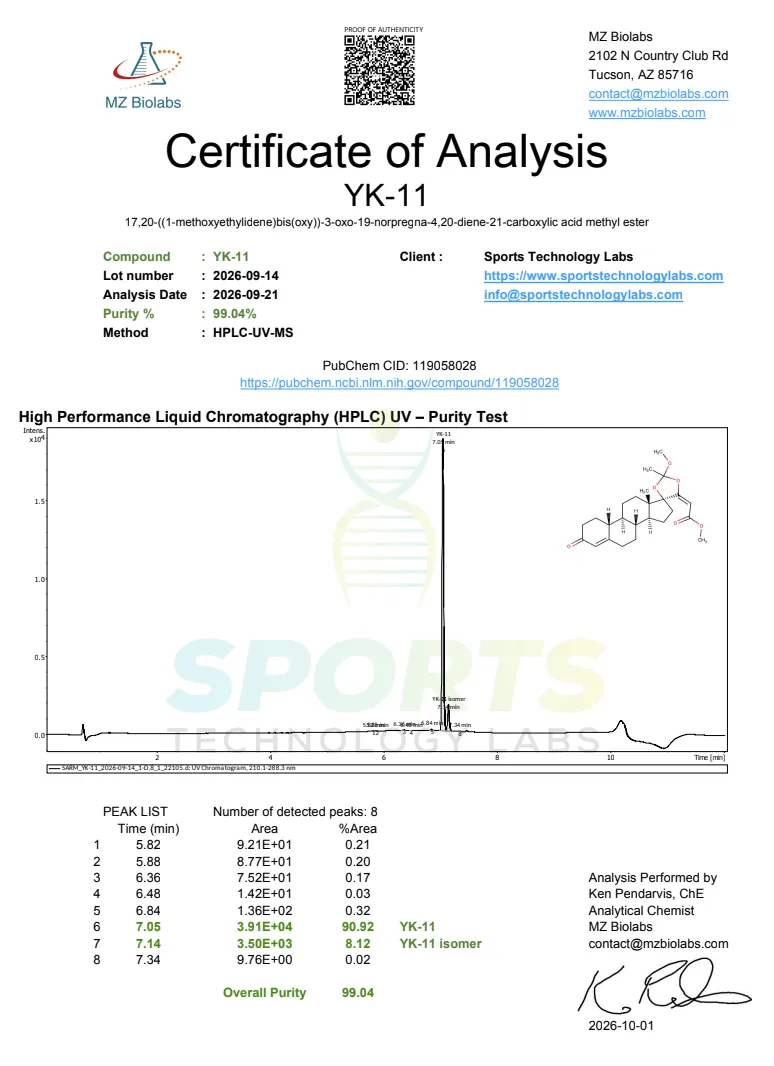
| Verified Purity | Batch-tested to 99.04% (HPLC) |
| Terms | For laboratory research use only. Not for human or animal consumption. |
Every batch is analyzed by an accredited US third-party laboratory before it ships.
Purity and identity confirmed by MZ Biolabs (Tucson, AZ), a US DEA-licensed analytical facility, via HPLC purity analysis and mass-spectrometry identity confirmation under GLP standards.
Our third-party certificates of analysis are published on our website — no login required.
Each bottle is formulated and verified for consistent label-to-bottle accuracy across studies.
Built to preserve compound integrity throughout your research timeline.
Quality control across the research-compound industry is inconsistent, which makes third-party verification essential. A 2017 analysis published in JAMA examined 44 products marketed online as SARMs and reported wide gaps between labels and contents.
Source: Van Wagoner et al., JAMA, 2017 (ref. 2).
Verified by MZ Biolabs (Tucson, AZ), an accredited US laboratory, via HPLC and mass spectrometry.
Suspended in the highest grade carrier and bottled in America.
Prevents BPA leaching and avoids contamination from external tools.
Transparent business, standard payment methods, no misrepresentation.
YK-11 is a synthetic steroidal compound that acts as a partial agonist of the androgen receptor in vitro. It is structurally derived from a steroidal backbone and is orally bioavailable in study models. It was first described in the research literature by Kanno et al. in 2011 (ref. 1).
YK-11 is commonly catalogued among selective androgen receptor modulators (SARMs). It remains an experimental research chemical, supplied strictly for laboratory research. Sports Technology Labs makes no claims regarding its effects, and nothing in this listing should be interpreted as describing outcomes in humans or animals.
YK-11 is an investigational compound. It is not approved by the FDA and is not a dietary supplement, drug, or food. Marketing it for human ingestion is unlawful.
Listed by the World Anti-Doping Agency under S1 (Anabolic Agents — Selective Androgen Receptor Modulators), banned both in- and out-of-competition (ref. 3).
In the United States, YK-11 is not a federally controlled substance and may be legally purchased and possessed for laboratory research use. Its legal status differs in other countries, where it may be restricted or controlled.
Sports Technology Labs are chemical suppliers, not medical providers. We do not condone or encourage consumer use of research compounds.
Research use only. All products on this website are intended exclusively for laboratory research and development. They are not for human or animal consumption. These statements have not been evaluated by the U.S. Food and Drug Administration, and these products are not intended to diagnose, treat, cure, or prevent any disease.
| Weight | 3.0 oz |
|---|---|
| Dimensions | 3 × 2 × 1 in |